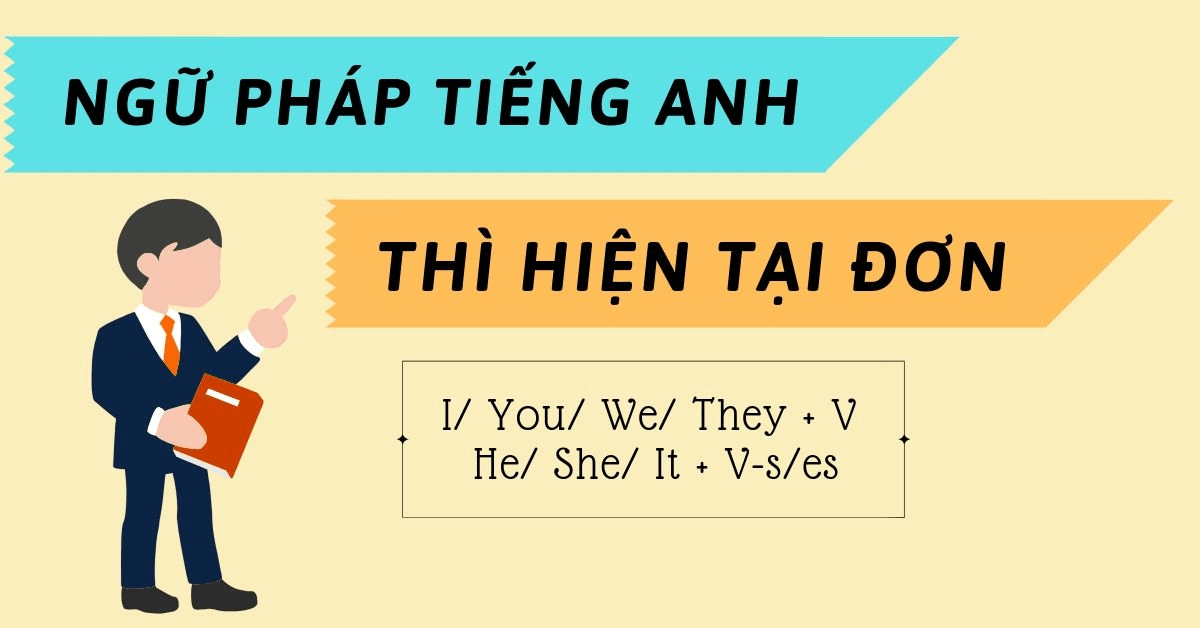
Thì hiện tại đơn là một trong những thì cơ bản và quan trọng nhất trong ngữ pháp tiếng Anh. Nó không chỉ đóng vai trò chủ chốt trong việc diễn đạt các hành động, thói quen hàng ngày, mà còn giúp người học xây dựng nền tảng vững chắc cho việc sử dụng các thì phức tạp hơn sau này. Bài viết này sẽ khám phá vai trò và ứng dụng của thì hiện tại đơn, giúp bạn hiểu rõ hơn về cách sử dụng thì này trong giao tiếp và viết lách. Thông qua việc nắm vững thì hiện tại đơn, người học có thể tự tin hơn trong việc thể hiện ý tưởng và cảm xúc của mình bằng tiếng Anh.
I. Subject pronouns:
Đại từ nhân xưng chủ ngữ được sử dụng để thay thế danh từ làm chủ ngữ trong câu, giúp tránh lặp từ và làm cho câu văn trở nên mạch lạc hơn.
I like coffee.
We like coffee.
You like coffee.
He likes coffee.
She likes coffee.
They like coffee.
It is a good story.
– Đại từ nhân xưng chủ ngữ làm chủ ngữ trong câu.
– Là chủ thể gây ra hành động (thường đứng đầu câu).
II. Object pronouns (Đại từ nhân xưng tân ngữ)
Tom often tells me a story.
Tom knows us.
Tom knows you.
Tom knows him.
Tom is talking to her.
Tom knows them.
Tom knows it.
– Đại từ nhân xưng tân ngữ làm tân ngữ của động từ hoặc giới từ trong câu.
– Thường được đặt sau động từ hoặc giới từ.
– Chịu tác động của chủ thể gây ra hành động.
**NOTE:
Ø Đại từ có cùng nghĩa như danh từ, dùng để đề cập đến danh từ trước đó.
I often meet Susan. She is a student.
I have a car. It is red.
I love dogs. They are lovely.
I like Peter. I know him well.
These are good books. I often read them.
Ø Khi nói về vật chung chung, ta dùng “it” để thay thế. Tuy nhiên vẫn có những trường hợp dùng “she”, “he” cho vật nuôi hoặc 1 số phương tiện như tàu, xe, …
This is our dog Rusty. He‘s very lovely. We really love him.
The Titanic was a great ship but he sank on her first voyage.
Ø Dùng “it” khi đề cập đến thời tiết, nhiệt độ, thời gian, khoảng cách
It‘s raining.
It will be hot tomorrow.
Is it nine o’clock yet?
It‘s 50 kilometres from here to Cambridge.
Ø Khi nói về người chung chung, ta dùng “she”, “he” hoặc “they” để đề cập đến người ấy
If a student needs help, he/ she/ they should see the teachers. (Nếu sinh viên nào cần giúp đỡ thì hãy gặp giáo viên)
Bảng tóm tắt:
| Number (số ít/ nhiều) | Person (Ngôi) | Gender (giới tính) | PERSONAL PRONOUNS | |
| Subject (chủ ngữ) | Object (tân ngữ) | |||
| singular | 1st | male/female | I | me |
| 2nd | male/female | you | you | |
| 3rd | male | he | him | |
| female | she | her | ||
| neuter | it | it | ||
| plural | 1st | male/female | we | us |
| 2nd | male/female | you | you | |
| 3rd | male/female/neuter | they | them | |
EXERCISE
Exercise 1: Supply the correct personal pronouns, using the hints in brackets:
0. ____loves dogs. (Mary) à She loves dogs.
- __________is dreaming. (George)
- __________is green. (the blackboard)
- __________are on the wall. (the posters)
- __________is running. (the dog)
- __________often give me presents. (Tom and Mary)
- __________are watching TV. (mother and I)
- __________are in the garden. (the flowers)
- __________has got a brother. (Diana)
- Have__________ got a computer, Mandy?
- __________are students. (she and he)
- __________ are lovely. (the cats)
- Peter, do __________know anything about her?
- The teacher always gives __________homework. (the students)
- I am reading the book to __________. (the little sister)
- I don’t know ____________. (the answer)
Exercise 2: Supply the appropriate personal pronouns:
0. Scott is a good man. _________ is also my best friend.
Scott is a good man. He is also my best friend.
- My name is Robert Fleck. __________am a doctor.
- Lucie isn’t from Russia. __________is from Brazil.
- I don’t know Steve’s wife. Do you know ____________?
- Alice and I are very thin! _________are top models.
- Elizabeth, Emily and John aren’t thin. _________ are heavy.
- Peter is Mary’s husband. ____________and his family are from London.
- I don’t know the man in the brown jacket. Do you know____________ ?
- My doctor is from Germany. ____________is a very good doctor.
- His friends are so strong. ____________ are athletes.
- Her name is Michelle. ____________is from Lyon, France.
- I don’t know those boys. Do you know ____________?
- A: Does Tom live near you?
B: No, ____________ doesn’t. ____________ lives near Linda. - A: Are you listening to English songs?
B: No, ____________ am not. I’m listening to Vietnamese songs. ____________ are great! - A: Are you a dentist or a doctor?
B: ____________ am a dentist. And ____________?
A: ____________ am a dentist, too. - A: Where are ____________ from?
B: I’m from France. How about ____________and the girl over there?
A: ____________ am from America. ____________ is from Brazil.
THE SIMPLE PRESENT TENSE OF “TO BE”
Trong thì hiện tại đơn (Simple Present Tense), động từ “to be” có ba dạng biến thể chính: am, is, và are.
Dưới đây là cách sử dụng các biến thể này với các chủ ngữ tương ứng:
* AM: Dùng cho chủ ngữ duy nhất là I I am… (= I’m…)
* IS: Được sử dụng cho chủ ngữ ngôi thứ ba số ít, bao gồm HE, SHE, IT và bất kỳ danh từ số ít nào.
She is… (= she’s…) He is …( = he’s…) It is …( = it’s…) The dog is… Peter is…
* ARE: Sử dụng cho chủ ngữ là YOU, WE, THEY, cũng như bất kỳ chủ ngữ số nhiều nào khác.
You are…(=you’re…) We are…( = we’re…) They are…( = they’re…) The dog and the cat are… Many students are…
*FORM:
Positive form: S + tobe (AM / IS / ARE ) + …
Ex: I am a teacher. They’re singers.
Negative form: S + tobe (AM / IS / ARE + NOT) + …
+Short forms:
I am not = I’m is not = isn’t are not = aren’t
Ex: He is not handsome. (He’s not handsome/ He isn’t handsome)
You are not stupid. (You’re not stupid/ You aren’t stupid)
Question form:
…. AM / IS / ARE + S + …. ?
Ex: Am I too fat? Are you ok?
* Use: Khi ta muốn giới thiệu tên, địa điểm, hoặc tính chất, trạng thái của một người, con vật hoặc sự kiện trong hiện tại.
I’m Mary. They’re at the cinema now. She’s happy. He’s a doctor.
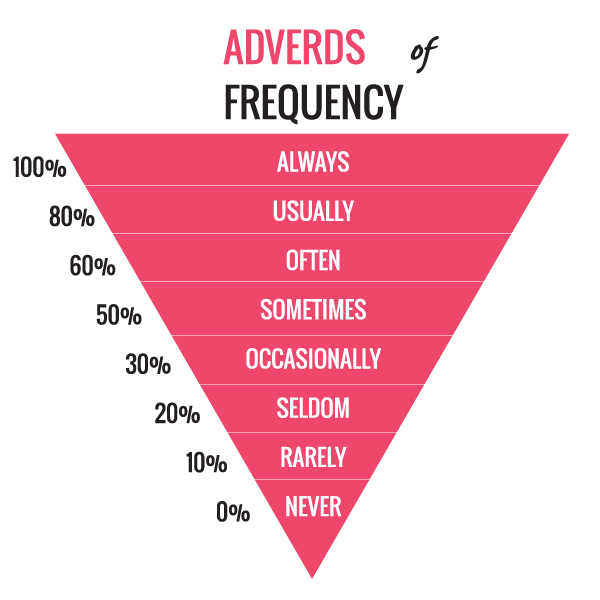
**ADVERBS OF FREQUENCY (Trạng từ chỉ tần suất ) WITH “TO BE”: always, usually, often, sometimes, seldom, rarely, hardly ever, never
She is always kind. They are sometimes late. Tom is never happy.
S + BE + ADVERBS OF FREQUENCY + ….
She is always/ usually/ often/ sometimes/ seldom/ rarely/ never absent from class.
**Using “TO BE” in present simple with “THERE” (“to be” được chia dựa theo danh từ đứng sau nó)
There is/ There’s a girl over there.
There are students in the classroom.
Is there a table in the kitchen? Yes, there is/ No, there isn’t
Are there any students studying? Yes, there are/ No, there aren’t
Ø Dùng diễn tả sự tồn tại, hiện hữu của người, vật, hiện tượng
Ø “How Many” with “Are There”:
How many + plural noun(danh từ số nhiều ) + are there (+ complement).
How many tables are there in your classroom?
How many girls are there in your class?
THE SIMPLE PRESENT TENSE OF ORDINARY VERBS
*FORM:
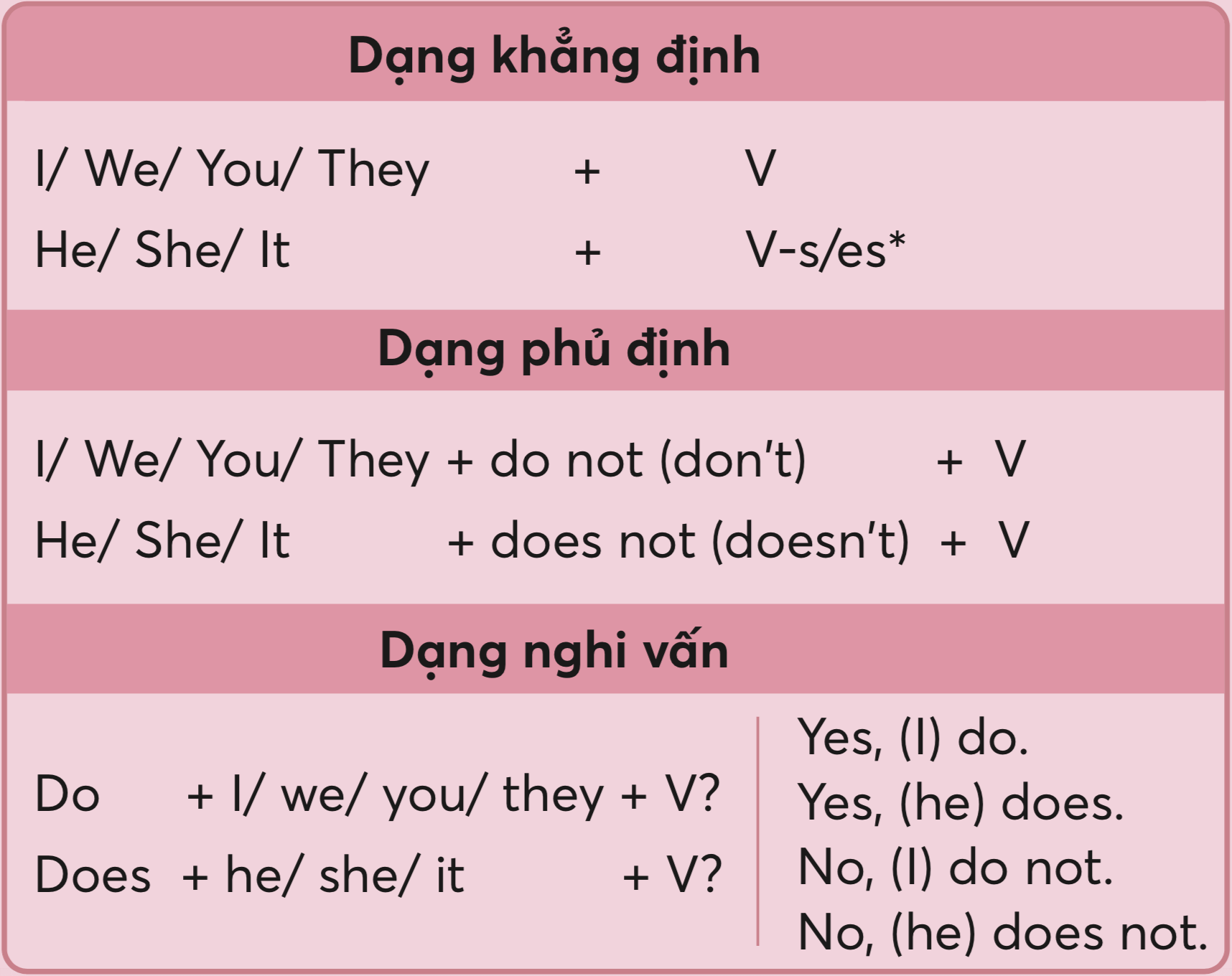
Positive form: I/ We/ You/ They/ Subject(số nhiều) + verb (bare-infinitive)
He/ She/ It/ Subject(số ít) + verb – s/ es
Negative form: I/ We/ You/ They/ Subject(số nhiều) + do not +verb (bare-infinitive)
He/ She/ It/ Subject(số ít) + does not + verb (bare-infinitive)
+Short forms: do not = does not =
Question form: … Do + I/ We/ You/ They/ Subject(số nhiều) +verb (bare-infinitive)?
… Does + He/ She/ It/ Subject(số ít) + verb (bare-infinitive)?
+ Do you like coffee? + Does she like me?
+ Where does Mary live? + What time do you go to school?
*NOTE:
Ø Động từ hiện tại đơn ở ngôi thứ 3 số ít được thành lập bằng cách thêm “s” vào động từ nguyên mẫu
sit -> sits work -> works
Ø Thêm “es” sau các động từ tận cùng bằng: ch, sh, o, s, x, z
watch -> washes miss -> misses go -> goes
wash -> washes mix -> mixes doze-> dozes
Ø Động từ tận cùng bằng 1 phụ âm + y, đổi “y” thành “i” rồi thêm “es”
study -> studies
Ø Động từ tận cùng bằng 1 nguyên âm + y, thêm “s”: (Những nguyên âm trong tiếng Anh: u, e, o, a, i)
play -> plays
Ø Ngoại lệ: have -> has: She has a good book.
Ø Khi đã mượn trợ động từ does/ do thì động từ theo sau không được thêm “s”, “es” vào động từ
She doesn’t knows how to play games. Peter doesn’t often washes dishes.
Ø Đối với động từ “to be” thì không được sử dụng chung đồng thời với động từ thường
I am love dogs. Are Does she like Peter? You are do well in class.
Ø Trường hợp nhấn mạnh hành động: (thêm “do” hoặc “does” trước động từ thường (động từ ở dạng nguyên mẫu)
I do love her She does like it very much.
Ø Cách phát âm đuôi“s”:
“s” sẽ đọc thành /s/: đối với những động từ kết thúc bằng các âm vô thanh (âm vô thanh: /t/, /f/, /k/, /p/, /θ/)
“s” sẽ đọc thành /z/: đối với những động từ kết thúc bằng các âm hữu thanh và các âm còn lại.
Ex: thinks ->think /s/ eats ->eat /s/ looks ->look /s/ hopes ->hope /s/
rides àride /z/ sees ->see /z/ drives ->drive/z/ lends ->lend / z/
Ø Cách phát âm đuôi “es”:
Ex: washes -> wash/iz/ watches -> watch/iz/
Ngoại lệ: goes -> go/z/ does ->/dəz/
**ADVERBS OF FREQUENCY WITH ordinary verbs: always, usually, often, sometimes, seldom, rarely, never
They always make me laugh. She never smiles.
S + Adverbs of frequency + simple present ordinary verbs + …
He always/ usually/ often/ sometimes/ seldom/ rarely/ never gets home late.
(Một số trạng từ có thể đứng đầu câu hoặc cuối câu: Sometimes I get up at 6 a.m./ I get up at 6 a.m. sometimes.)
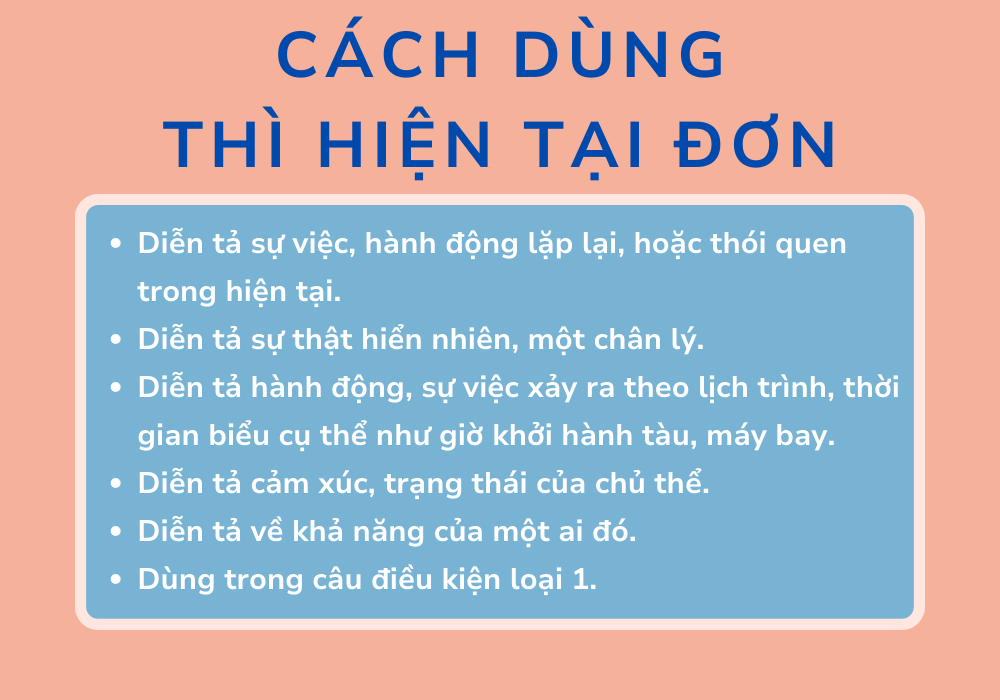
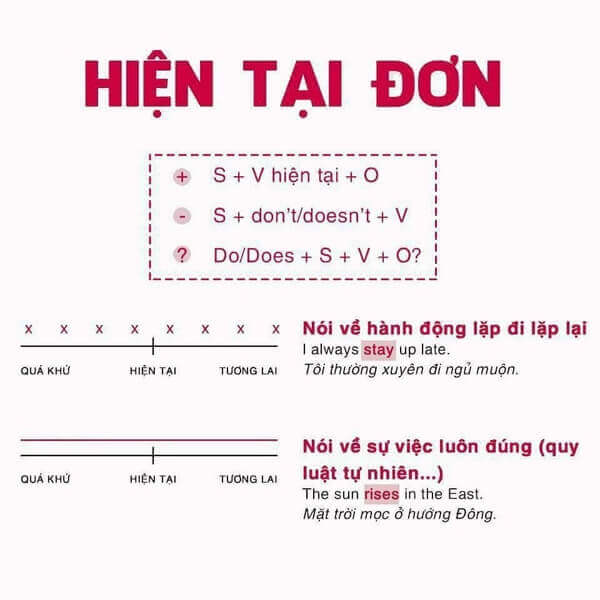
* USE: Khi nói về một thói quen, hành động lặp đi lặp lại trong hiện tại .
I get up early in the morning. What does she do every night?
Khi đề cập đến một sự thật khoa học hoặc một chân lý không bao giờ thay đổi.
The sun rises in the east and sets in the west.
Nhận thức, cảm giác, sở thích, tình trạng ở hiện tại.
Mary works in the post office. Do you see the girl over there?
**Dấu hiêu nhận biết: trong câu xuất hiện một số trạng từ always, usually, often, sometimes, seldom, rarely, never, every day/ month/ year, once a week/ month/ year, twice a week/ month/ year, three/ four/ five … times a year, …
** Các dạng câu hỏi với thì hiện tại đơn của động từ thường:
1.Yes – No Questions:
+ Question: Do + I/ We/ You/ They/ Subject(số nhiều) +verb (bare-infinitive)?
Does + He/ She/ It/ Subject(số ít) + verb (bare-infinitive)?
+ Answer: Yes, I/ We/ You/ They + DO.
Yes, He/ She/ It/ + DOES.
No, I/ We/ You/ They + DON’T/ DO NOT.
No, He/ She/ It + DOESN’T/ DOES NOT.
Ex: Do you work hard? –No, I don’t/ Yes, I do
Does Mary love you? –No, she doesn’t/ Yes, she does.
2.Wh-Questions: (Từ hỏi là Where, Who, Why, When, What, …)
+ Form: Where/ What/ Who/ When/ Why…. + does/ do + S + Verb (bare-infinitive) + ….
+ Answer: I/ We/ You/ They/ Subject(số nhiều) + verb (bare-infinitive) + ….
He/ She/ It/ Subject(số ít) + verb – s/ es +….
Ex: Where do you live? _I live in New York.
What time does she get up? _She gets up at 7.00 a.m.
EXERCISE
Exercise 1: Supply the correct forms of “be”:
1. He……………. an engineer.
2. She……………..my old friend.
3. It……………five o’clock.
4. I…………..tired.
5. We…………….good friends.
6. You………………a bad boy.
7. They……………..intelligent.
8. Mary…………….beautiful.
9. My cat………….very lovely.
10. Her sister………………young.
11. The students……………..back to school now.
12. Peter and I………………..good football players.
13. He and She……………….great couple.
14. Sugar……………. necessary for your health.
15. Vegetables…………….good for you.
Exercise 2: Change the following sentences into positive and negative sentences:
0. Some students are very active.
->Are some students active?
->Some students are not very active
1. Fruits are good for our health.
……………………………………………….
………………………………………………..
2. They’re good people.
……………………………………………….
……………………………………………….
3. It is a good book.
……………………………………………….
……………………………………………….
4. I’m very tired.
……………………………………………….
……………………………………………….
5. Peter and Mary are friends.
……………………………………………….
……………………………………………….
6. These books are interesting.
……………………………………………….
……………………………………………….
Kết luận, Thì Hiện Tại Đơn không chỉ là một trong những thì cơ bản nhất trong ngữ pháp tiếng Anh, mà còn đóng vai trò quan trọng trong việc diễn đạt những sự thật, thói quen và hành động thường xuyên. Việc nắm vững cấu trúc và cách sử dụng của thì này sẽ giúp người học tự tin hơn trong giao tiếp hàng ngày, đồng thời là nền tảng vững chắc để tiếp thu các kiến thức ngữ pháp nâng cao hơn. Hãy thực hành thường xuyên và áp dụng vào cuộc sống để thuần thục hơn với Thì Hiện Tại Đơn!
Nếu có bất kì thắc mắc gì về các khóa học tiếng Anh thì hãy liên hệ với chúng tôi nhé!
Thông tin liên hệ:
o Địa chỉ:
_Cơ sở 1: Số 178 Trương Tấn Bửu, Kim Dinh, Thành phố Bà Rịa,Bà Rịa- Vũng Tàu.
_Cơ sở 2: Số 31A Ngô Quyền, TT Ngãi Giao, Huyện Châu Đức, Bà Rịa- Vũng Tàu.
o Điện thoại: 0934.499.345 – 0985.154.679
o Website: https://tanika.edu.vn/
o Fanpage ngoại ngữ: facebook.com/TrungtamNgoainguTanika
o Fanpage Du học: facebook.com/DuhocTanika
o Fanpage Du học –Châu Đức: facebook.com/tanika.chauduc